Your Assignment Toolkit
Part 2: Researching your assignment
Guidance for how to use search engines, resources and strategies when conducting research.
/prod01/yorksjacuk/media/content-assets/safe-images/1600-x-1000/campaign-shoot-2026---around-campus---general-images---31-(1).jpg)
The Research Process
Research is a continuous process that takes time and effort. It involves asking questions and bringing together evidence from multiple sources to answer them. At the start, it can feel overwhelming, and you may not know the answers yet, or even be fully sure of the questions. That’s a normal part of research.
To make research more manageable, break it down into stages:
- Planning your search (keywords and scope)
- Identifying appropriate types of information
- Finding and accessing sources
- Keeping records of your searching
- Evaluating what you find
2.1 Before searching: where to start
Before you start searching you need to know what you are searching for. This section looks at breaking down your research topic / assignment question to identify the keywords you can use in your searches.
Your keywords are the main terms you enter into search tools. Choosing effective keywords is essential to finding useful resources.
For example:
What is the effect of climate change on the tourism industry in Australia?
Key terms:
- climate change
- tourism industry
- Australia
Use these key concepts rather than full sentences when searching.
Tips:
- Start with a few keywords. You will refine them as you research.
- Look at reading list titles for useful terminology.
Different researchers may use different language for the same concept. You can find alternative keywords through your reading, in thesauri, or using a search engine.
Examples:
“Higher education” vs “university”
“Global warming” vs “climate change”
Using alternative terms will broaden your search and improve results.
You can combine keywords in a search engine to control your results:
- AND → narrows (climate change AND tourism)
- OR → broadens (teenager OR adolescent)
- NOT → excludes unwanted results
Use quotation marks for phrases:
- “tourism industry”
AI tools can help to suggest keywords. A prompt in an AI chat tool can help you come up with search terms to use in search engines:
“Help me mind map possible keywords for my search for academic sources”
However:
- Always follow your task or assignment guidance for what you are allowed to do. If an assignment or task is testing your ability to find and come up with keywords yourself, using AI may not be appropriate.
- Be aware of AI limitations and inaccuracies (how can you check that the suggested search terms are appropriate?)
- Use AI tools to support, not replace, your research process
Key resources: Your Critical AI Toolkit
2.2 Types of information and resources
As well as keywords, you need to decide what kind of information you need.
At Level 3 (foundation degree) and Level 4 (first year undergraduate), your assignment briefs will often give instructions on what types of information you are expected to include. At Level 5 and 6 (second and final year undergraduate) and Level 7 (postgraduate), your assignment briefs may give fewer instructions and expect you to use your academic and professional judgement to choose appropriate information types for the assignment.
This section breaks down the different types of information and resources to help you identify what information you need, where best to find it and help to evaluate its suitability.
Learn more about the different types of information resources used in academic study below.
Types of resources
You will come across many different types of information during your studies and research.
Get to know more about each type using the sections below.
You will often hear academics talk about academic and scholarly sources, and conversely, non-academic and non-scholarly sources. What they mean can vary slightly between each subject, but in general, this is what they mean.
Academic sources:
- Written by experts (academics and researchers)
- Evidence-based (data, references, research)
- Often peer-reviewed (such as academic books and journal articles)
Non-academic sources:
- General audience (websites, blogs, media)
- May not be fully referenced
- Useful for context or public perspectives
Thinking and writing at university always has an expectation that you read and use academic sources. Your subject area will have other information source types that are not traditionally academic sources, but they are highly valuable and important to how your subject is studied and practised. Your lecturers scaffold the learning in your modules to introduce this to you.
In general:
- At Level 3 (foundation degree) and Level 4 (first year undergraduate): you must be using academic sources as a minimum. You may have other important information types you are asked to use.
- At Level 5 and 6: you must be using academic sources, and usually using an additional wider range of information sources appropriately and critically.
- At Level 7: you must be using academic sources, and usually using an additional wider range of information sources appropriately and critically.
Some subject areas talk about information sources by describing them as primary, secondary or tertiary. If you come across this, it means:
- Primary sources: original data or evidence (for example: studies, reports, interviews, historical records)
- Secondary sources: analysis or interpretation of primary sources
- Tertiary sources: resources that summarise and index primary and secondary resources (for example: encyclopaedias, dictionaries, handbooks)
Primary and secondary sources are usually what you are expected to use the most in assignments. Tertiary sources are good places to start with your learning in a topic area, but usually should not be the final sources you use in your assignments.
It is useful to understand the most commonly used source types you may reference during your studies.
Some subject areas, such as Arts and Humanities, also publish monographs which are books exploring research on a single subject in detail, usually by 1 or 2 authors. These are typically more specialized than general textbooks.
Textbooks are one of the most common types of information used in university studies. Many contain practical advice and outline key concepts and theorists linked to your chosen subject. You can use them as a starting point to find out about a topic that is new to you.
Some textbooks are written entirely by 1 or 2 authors: more specialist books can have different authors for each chapter and the whole work is brought together by editors. These types of edited books will contain chapters of detailed research about specialist topics within that field.
Often you will need to read just a section of a textbook, rather than the whole thing.
A lot of textbooks are available online as well as in print.
Journals are published in a similar way to newspapers and magazines: there are a number of issues each year and each issue contains articles.
Journals can also be called periodicals or serials. There are different types:
Academic journals – articles reporting results of recent research about a specific topic in a field of study for an academic audience. These can include literature reviews on the current state of knowledge on a topic. The authors must include evidence to support their arguments and research in the form of data and references. These journals are usually peer-reviewed which means that the articles are submitted to a process of rigorous review to check content and accuracy by peers – other academics and experts – before acceptance into the journal.
Professional journals – professions such as teaching, accounting, nursing, and human resource management will publish journals often linked to professional associations. Keeps up to date with current trends and developments in the profession. Useful for current awareness aimed at a practitioner not an academic audience.
Magazines – current affairs content or topical short articles such as Time or Psychology Today for a general audience. Useful to keep up to date with developments in the subject area and new topics of interest, but not fully referenced.
You'll need to understand the background to your subject area before reading journal articles. Although they are shorter than books, they go into a lot of depth on a narrow topic and will assume prior knowledge.
Newspaper articles are useful for finding reports of current events and providing evidence of the media or public response to an event, person, policy or initiative. The majority of newspaper articles will involve some form of bias, either from the author or the editorial agenda of the publication.
Academic research can also use a wider range of sources, with each discipline using and valuing these source types differently. Use the concertina menu below to explore source types that can be common in some disciplines.
Case studies focus on a particular group or company. They will investigate initiatives and developments linked to that group and report on the findings. They are useful for when you need to examine the impact of a certain strategy or initiative and its successes and failures within a certain business type. They will often use qualitative and quantitative data to support findings and may make recommendations as to how future strategies and initiatives could further build on the research.
Company information outlines the origins, revenue, size and organisational type of company in question. It also includes SWOTs, which are analyses that look at factors influencing strategies and decisions such as Strengths, Weaknesses, Opportunities and Threats, as well as financial performance, competitors, and contextual industry information.
A conference paper is the text of a paper or presentation given at a conference, seminar, symposium or similar which has been organised by a society or an organisation. They are sometimes compiled together with other papers presented at a single conference, which are referred to as conference proceedings. Recent conferences in your subject may provide you with current research, or new methodologies in your field of interest. In some fields, such as Computer Science, conference papers are often subject to a peer review process, while in other fields there may be another process for acceptance to a conference.
Country and city information refers to data that explores macro factors that affect industries or sectors within which a business operates. This can include government policies, cultural norms, infrastructure, demographics, and more. One type of analysis that is prevalent in this information is PEST analysis, which explores the Political, Economic, Social, and Technological factors that affect businesses.
Governmental and parliamentary sources are available, some through free services and some subscription-based services. This may include reports, legislation, policy papers, research and statistics, consultations, communications, and more.
UK census data and Parliamentary information, such as the transcript of debates in Hansard, is available via Government websites.
All of these can be found on the Subject resources and databases: politics list.
Grey literature is the name given to different types of publications that are unpublished or published in a non-commercial form.
Examples of grey literature include reports, pamphlets, clinical trials, policy statements, conference proceedings, theses and fact sheets. Grey literature can contain high quality information, but it is unlikely to be peer-reviewed so it is important to critically evaluate it before using it.
There is no one place to look for grey literature. Where you search will depend on your topic and the type of literature you are looking for. Consider searching relevant organisational websites (e.g. professional organisations, charities, gov.uk). If you are looking for a certain type of literature, try filtering the Subject resources and databases list by ‘Types’ to see which resources would be useful.
Historical newspapers refer either to the text from historical newspapers, or to scans of the actual text and layout from the original.
There are several newspaper search tools available through Library and Learning Services.
You can search these resources on the Subject resources and databases: newspapers list.
From art and museum image libraries, theatre productions and photos to film and documentary streaming, interviews and more, the library subscribes to several databases and services which provide high-quality visual material.
Legal materials encompass a few different types of resource, all of which are curated and created to assist those in legal professions. This may include commentaries, reports, newsletters, blogs, consultations, updates, and insights. These may come from curated databases or from external organisations and networks.
Legislation refers to laws that have been passed by government, as well as the different versions of those laws. Primary legislation is the term for laws passed by legislative bodies, such as the UK Parliament, and may sometimes be called Acts; whereas secondary legislation refers to laws created by government ministers or agencies, within the scope of powers given to them by primary legislation. Case law refers to laws that are created by rulings in court, rather than by legislative bodies or agencies. These rulings create precedents that must be followed by courts in the future. A wide range of available databases provide access to UK, US, and EU legislation and case law.
Map data is available via the Subject resources and databases: maps list. Our main map resource is Digimap, where you can find Ordnance survey maps, and also a wide range of other types of geographical data including geological, environmental, census, historic and aerial.
Market information refers to data that details the contextual environments of individual businesses and their relationships with customers and demand, and can encompass a few different resource types, includes statistics, market research reports and consumer surveys. Industry information focuses less on consumers and more on the competitive environments of different businesses. This might include information on key businesses and groups, trends, supply chains, and barriers to entry.
Music manuscripts include study scores, solo and ensemble performance scores and full orchestral scores. You can find physical scores within the library collection, or we have several online databases that provide scores and audio recordings.
National guidelines aim to use the best available evidence to provide recommendations to help improve health and social care.
Good places to begin your search for this type of information include:
Inspection reports are often used to give background information regarding a school. You can find these reports on the
Ofsted website, which is on the list of Education subject resources and databases.
Government guidance for the implementation of legislation is found in policy documents. Examples of these include the National Curriculum and the Special Educational Needs and Disability Code of Practice.
A lot of this policy documentation can be found with a Google search. You can use the advanced search option in Google to restrict to UK government websites only if you need UK policy. Alternatively, you can search on gov.uk directly.
Many primary resource collections are freely available to access online. In some cases you may find you will need to visit collections beyond the University where resources have not been digitised.
Primary sources and archive collections are available both through the Library and public collections. You can search these resources via the Subject resources and databases: primary sources list.
Legal dictionaries are resources that define concepts and terms that are often used within the legal profession. These resources are the place to look when you find yourself confused by legal jargon and Latin maxims or need to find the meaning for a particular abbreviation. Of particular importance is the 'Halsbury’s Laws of England'.
A systematic review is a type of research method that outlines and critiques all the available information on a specific topic. This is a key research method for subjects in the social sciences.
Trade and industrial publications can provide useful information from a non-scholarly perspective.
These publications have usually not undergone academic review, so you should evaluate the information to see if it is appropriate to use in your research. Ask your tutor for further advice on this.
To access trade and industrial publications, search our databases and choose 'magazines' and 'trade publications' from the source types.
2.3 Carrying out a search
In your searching toolkit, you should now have:
- Keywords and ideas of what you want to find
- Types of information and sources you need to find your keywords and ideas in
You need to combine those together by:
- Choosing search tools that will help you find the information and sources you need
- Using your keywords to search in those tools
In this section, we will introduce you to important search tools you should use and how to use them effectively.
Search tools
You will use a range of information resources throughout your degree and assignments (as described in 2.2 Types of Information and resources). Finding the search tool that matches the type of information you want to use and your research approach can save you a lot of time. You will need to try several search tools and different combinations of your keywords to make sure your searches are thorough and results are relevant.
Here are some of the main search tools we encourage you to use.
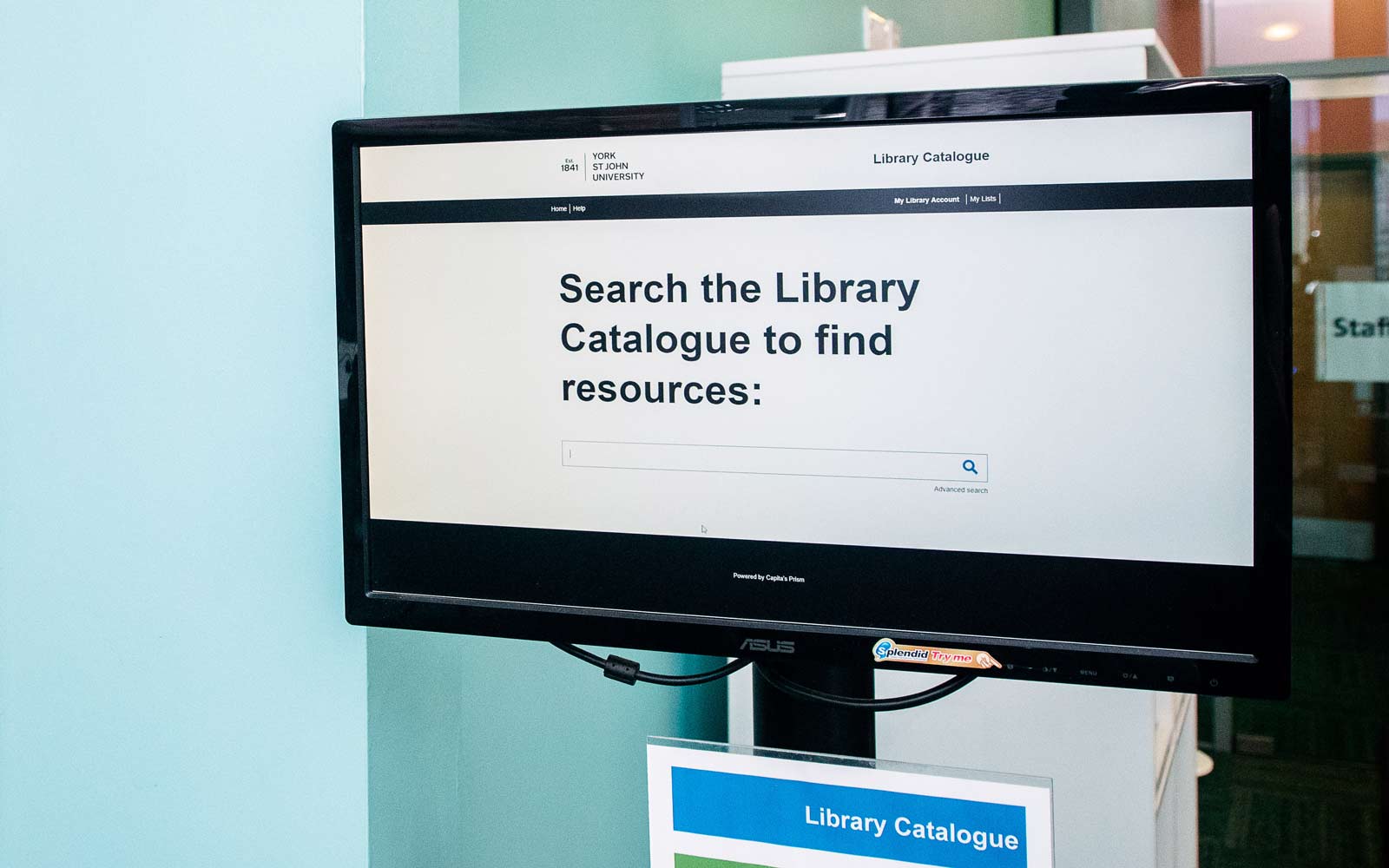
The library catalogue has two search options, books only or the wider library search.
Start with the book only search to find books about key topics and ideas. Books are usually about a broader theme, so if your search is too specific, try using broader keywords.
Change to using the wider search to find more specific academic research. This search allows you to filter across a range of different resource types including books, journal articles, conference papers, newspapers and more.
These search tools are the most important ones you should always start with.
Google Scholar is like Google, but the results are from academic research. When you search Google Scholar, you will find that a lot of the results are journal articles. Like newspaper articles, journals have their own websites where you can access articles. However, many have a paywall. The Library has paid for you to be able to access those that are in our collection, but you will need to set up Google Scholar Library Links. This will make sure that you can access our books and journals without payment requests.
/prod01/yorksjacuk/media/content-assets/safe-images/480x320/Students-in-Library-29-480-x-320.jpg)
I've done my search: what now?
You now have your search results. If you are happy with the initial results (for example there are relevant results, or a manageable number to look at), you can move onto 2.4 Keeping records of your search and 2.5 Evaluating your results.
A normal part of the search process is needing to change or improve your approach to searching as you learn how search engines work, about how language is used to describe the topic you are researching, or what is being researched.
Below are our suggestions of what you can try now.
If your search has produced results that aren't relevant to your question, try the following:
- Think of alternate search terms with the same meaning and try a search using those. For example, 'higher education' instead of 'university'.
- Try a concept that is wider than your original choice. For example, 'primary education' instead of 'Key Stage 1', or 'media' instead of 'television'.
- Choose a smaller number of keywords from your question, instead of searching all the terms at once. For example, 'petrol tax car use' instead of 'the impact of higher petrol taxes on annual car mileage'.
- If you are searching for books, remember that a textbook will likely have a title that reflects a broad topic area, so search on that basis, and you can then use the contents and index pages, or search functions in ebooks, to locate the specific section that aligns with your needs.
- Change the search tool you are using. A different tool could give you more relevant results, or may be better suited to the type of information you need.
- Journal articles, books and other sources can also be useful as a search tool themselves. If you have found an article that is relevant to your topic, check out that source’s reference list / bibliography to quickly find other resources.
You may find that your search has produced too many results and it is difficult to find what you need. Try the following:
- Make sure your search tool is ranking the most relevant results first. If the tool doesn't have this as a default setting, you can change the settings yourself.
- Add more keywords to your search to make it more specific, if your question requires detail. For example, add a population group such as 'children', or a country or location.
- Whilst you may use different search tools, they will have the same or similar features. Filters are particularly useful at helping you narrow down results or browse your topic area. Use filters on the wider library search or specialist subject resources and databases to refine your search.
- Check the dates of the results. You can filter results to include recent publications only, or rank results by most recent first.
- Ask the search tool to only locate the words you are using in the title, or the abstract (brief description), of the document.
Search tools can be literal and need to be told exactly what you mean. There are established shortcuts to help with this. Common shortcuts include:
- Using an asterisk (*) at the end of a word stem will find any ending of that word. For example, searching the term 'learn*' will automatically find results for words like learners, learning, learned, and learnt.
- Using a hashtag (#) in a word will find alternative spellings. For example, searching for 'col#r' will find results for both 'colour' and 'color'.
- Using quotation marks around words will find results where they are used as a single term, not separately. For example, "higher education" or "global warming".
Searching globally
Many of our students and degree programmes are focusing on studying and researching UK contexts, which means that many of our academic research tools are provided to enable this. This may not be true for you however, especially if:
- You are studying a degree programme which is a globalised one
- You are studying a degree programme which has a range of global focuses
- You are doing a task or assignment where global perspectives are important or expected
Many of the most common academic search tools are focused on the UK, Europe or the USA. You can find a list of search tools which provide a wider global context than this on the Specialist subject resources: global list.
Many of our tools which find professional, industrial, government, legal and societal information are produced by organisations focused on UK contexts. We do not list every global variation of these in our Specialist subject resources, so you should explore what search tools exist to help find that type of information in the country you are exploring.
You will find that many search tools have filters to allow you to restrict your results to a specific language or geographical area – check these out if you want to focus your results.
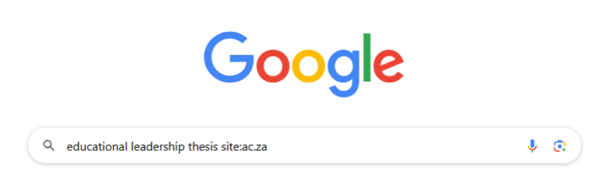
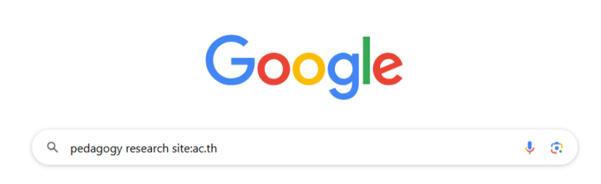
You can do a normal Google search, and ask it to only bring back research from specific countries, by using the site: instruction. You need to locate the Internet domain for the country, and then incorporate it with the ac. academic designation. For other types of non-academic sites, use the most common web address ending for that country.
For example, you can locate theses from South Africa by adding site:ac.za to the search:
You can find research from Thailand by adding site:ac.th to the search:
Whilst many academic and professional concepts are shared globally, we should also expect that global diversity and difference leads to geographic and regional differences in what is researched, how ideas are described in what people say and write, and where they say and write it. Translation into and out of English also impacts how ideas are described. Publishing is also expensive which impacts who can publish their ideas and where.
A search for an idea or concept in research from different countries that gives you fewer results does not necessarily mean there is no research. It could mean:
- The concept or idea is described using different words
- The concept or idea is understood and written about differently
- The concept or idea may have a different research priority
- The concept or ideas may be being shared in other information source types
Don’t give up! You can:
- Try different search tools including finding tools specifically for that country
- Try a non-academic general search engine to see how these ideas or concepts might be being described in different countries
- Talk to your lecturers – they are professional researchers in your discipline who can give you suggestions about what to look for
- Try a range of keywords and the country you are interested in. If you finding the right words for the geographic or cultural context, an asking an AI tool could be helpful here.
2.4 Keeping records of your research
It is important to keep a record of where you are searching, and the words you use. Doing this will ensure you are:
- documenting your learning, for example for a learning journal, and
- developing your critical searching skills.
Your assignment brief may also ask you to provide evidence of your searches and your learning to show you have not relied on generative AI for your assignment.
Some subject areas require a specific approach to searching, with a documented account of your search words and how they link together. You should check your assignment brief for this. Common approaches for creating your initial search question include the PICO approach (patient, intervention, comparison, outcome) in healthcare research.
There are options in most online search tools for saving and sharing what you have done. In addition to this, you can use reference management tools to save the sources you locate, and reference them in your work. You can also use our templates:
2.5 Evaluating your results
In an academic context, evaluating the sources you have found and used is vital to making sure your arguments are well-evidenced. There is a lot of misinformation available online so you want to ensure that any evidence you have used is reliable. You also want to make sure any resources you’ve found are relevant to your research before you invest time in reading them.
Active reading to learn and find answers in your sources comes later in the assignment process, and we will explore more about active reading later in this toolkit.
Key resources
Reading for your assignment: moving from information to understanding
Study Development resources on Making Notes and Active Reading
Academic vs. Non-academic sources
Earlier in this toolkit, we talked about academic and non-academic sources.
Early in your studies, academic staff often emphasise the importance of finding academic sources to use in your assignment, such as journal articles, rather than relying on non-academic sources like websites and blogs. However, exactly what is considered an appropriate academic source varies depending on your subject. If in doubt, ask your lecturers for guidance.
It is still important to evaluate all resources you use, regardless of whether they are ‘academic’ or not. Doing an initial evaluation of a source is not about finding out all the answers you need to know, but about deciding whether this source is appropriate to use for the task you are doing and how you can use it.
Evaluation is something you need to do for your university work, but is also a professional skill for work (what information do we trust and use to help make decisions at work?) and in our personal lives (such as how much we trust and use information in news stories, or how we find and make decisions from health information).
Top Tip: Want to quickly find something on a page when evaluating it? Use CTRL-F in Windows, CMD-F on Mac, Find on Page in iOS and Find in Page on Android, to locate specific words in documents and web pages.
Below are two possible models you can use to evaluate sources you find.
CRAAP Test
The CRAAP Test is an evaluation method that was designed by librarian Sarah Blakeslee at the Meriam Library California State University, Chico, and released under a CC-BY licence, The CRAAP test allows you to quickly evaluate whether a resource is useful and relevant for your academic work.
When was the resource written?
- Was it written recently? Consider here what counts as ‘recent’ in your subject area as this can vary.
- If you are viewing the resource online, is a 'last updated' date included?
- Are any links in the resource still active?
- How does it compare to other resources on the same topic? Are there more recent pieces of information available that you could use instead?
Is the resource relevant to your research?
- Does the resource relate to your topic or answer your question?
- Have you read the abstract for the resource to ensure it is relevant?
- Have you used CTRL+F to check that your topic keywords are mentioned in the full text of the resource?
Who wrote the resource?
- Is there a named author? Is it an individual or an organisation? Or was the resource produced by AI?
- Can you find out more about the author? What else have they published? Are they affiliated to a particular company, charity or university?
- Are there contact details for the author?
Double-check the information given
- Is there another website that also considers the topic? How do they compare?
- Is the subject covered on a fact-checking site such as Full Fact? Remember to check possible biases of fact-checking sites too.
- Is it clear where information given within the resource comes from?
- Are there references at the end of the text that you can follow up? Can you verify that these references exist?
Why was the resource written?
- Who is the intended audience: academic, professional, or general public?
- What is the purpose of the resource? To inform, educate, argue, promote? Can you detect a bias?
- Whose voice is being expressed? The author's? Does the author claim to speak for others? Under what authority?
- Has the resource been sponsored?
CCOW model
An alternative method of evaluating sources is the CCOW method, designed by librarian Anthony Tardiff at Foley University, Gonzaga.
- What’s the author’s educational background?
- What's their occupation?
- Do they have any other experience that might make them a good source of information?
Investigate the accuracy of their claims by seeking out what other authors are saying about the same topic.
- Why was this piece of information created?
- What did the author accomplish?
Be conscious that behind every piece of information is an author with their own biases and worldviews, and that you as the reader have your own set of biases and worldviews. Understanding these differences can help enable discussions rather than dismissal of views different to your own.

Summary
Researching your assignment is an exciting process of discovering sources that help you understand your topic and gather evidence, making use of a range of search tools to explore.
The next section of the Assignment Toolkit will guide you through producing your assignment, including reading, thinking, and writing/creating.