Graduation
Graduate success stories
Each year during graduation, we celebrate those graduates who have gone the extra mile to achieve their degree.

Every student has a story to tell. Hear from our Class of 2026.
Be inspired by our incredible students and hear more about their journey here at York St John University.
Jump to a profile:
Abi Gough, BA Drama, Education and Community
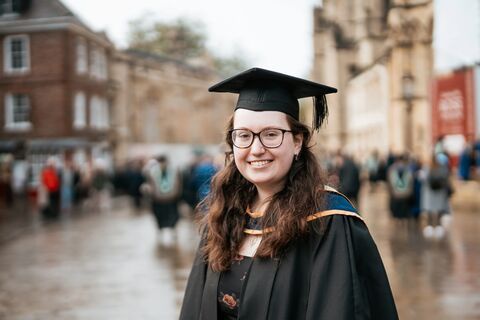
Over the course of my degree I became increasingly interested in how creative practice can be used to challenge inequality and increase participation. Living with chronic illness shaped my perspective and motivated me to advocate for others throughout my time at university. Looking back, my understanding of social justice was shaped by a simple but powerful question: who gets excluded, and how can we remove those barriers?
During my time at York St John, I was encouraged to step outside my comfort zone by my tutors. Not only did this help me grow, but these opportunities were some of my most meaningful experiences as a student.
One of the most significant experiences of my degree was a volunteering placement at Applefields School. I helped co-create immersive and sensory theatre experiences for children with Profound and Multiple Learning Difficulties (PMLD) to support communication, engagement and self-expression. This placement helped me see first-hand how creative environments can enable young people with complex needs to engage with the world around them in ways that traditional educational approaches do not always enable.
My placement also inspired my dissertation and final year independent project. My dissertation explored how participatory theatre can improve access for children with PMLD and address barriers to inclusion within education. I further explored this for my final project and co-devised a performance lecture examining and challenging communication between healthcare professionals and patients.
Looking ahead, I hope to qualify as a Dramatherapist and work within the learning disabled community. To support this, I’ve enrolled on a Dramatherapy MSc at Queen Margaret University in Edinburgh to continue building a society where everyone feels included, valued and empowered to participate on their own terms.
After finishing university, I decided to stay in York, a city that had become a second home to me. I now work for City of York Council’s Together We Can service, which runs the city’s only two children’s residential homes. As a residential care practitioner, I work 24 hour shifts supporting young people in their day-to-day lives, helping them feel safe, valued, and ready to move towards independence. It’s a challenging role at times, but also deeply rewarding. Every day brings a new opportunity to make a difference, whether that’s through offering emotional support, helping with education or life skills, or simply being a consistent and trusted adult presence in their lives.
My dream is to work in the voluntary sector with children’s charities, particularly with young carers. Having been a young carer myself, I know how vital that support can be. My journey from caring at home to university and now into my current role has taught me resilience, empathy, and the value of connection.
Dr Jan Hanson, Doctorate in Education
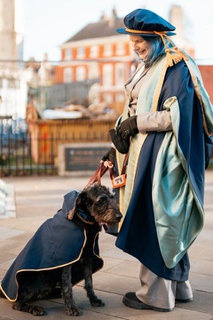
After more than 9 years supporting neurodivergent students and employees through Neurobox, a workplace adjustments provider, and my own practice, Difference in the Making, I decided to pursue a Doctorate in Education at York St John. I wanted to understand what happens when students graduate and the support they have relied on comes to an end. My research explored how institutions could better support neurodivergent graduates as they move from education into employment.
Alongside the professional study elements of my doctorate, my time at York St John transformed my understanding of myself. Diagnosed with dyslexia and dyspraxia at 30, autism at 56 and ADHD during my research, I moved from studying neurodivergent students’ experiences to reflecting on my own. Although doctoral study sometimes felt lonely, York St John always made me feel welcome and valued. Its inclusive approach helped me feel at home, with my assistance dog, McGee, accepted as a natural part of university life.
The support of my supervisors and the Postgraduate Research School helped me navigate the challenges of doctoral study. And McGee, my black Lurcher, has been beside me throughout. He hears for me; I have a hearing impairment, and he alerts me to what I miss. He is not equipment. He is my colleague, my friend and my running partner. From supervision meetings to conferences and writing retreats, his practical and emotional support has been invaluable. York St John never treated him as an inconvenience but recognised his contribution by creating a Dogtor of Education certificate to present alongside my own doctorate. This thoughtful gesture acknowledges that inclusive environments enable disabled researchers to do their best work.
I’m continuing my work supporting neurodivergent students and employees, alongside a new role as a visiting lecturer at York St John. Putting my research into practice, I want to influence how universities and employers support neurodivergent people beyond graduation. My doctorate is in my name, but I did not complete it alone. York St John’s support and McGee’s unwavering companionship made this journey possible. There are a great many people, particularly women of my generation, who have spent a lifetime believing they were failing at things everyone else found straightforward. I would like them to know that finding out late is not the same as finding out too late.
Ndey Kah, BA Counselling and Mental Health
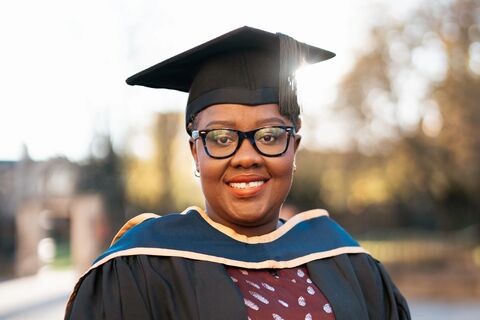
My journey to university was not a traditional one. Before coming to York St John, I had spent a significant amount of time away from academic study, working in retail for over 10 years before moving into a role within the NHS. My decision to study Counselling and Mental Health was deeply personal, shaped by my own experiences of mental health difficulties and a growing interest in people, emotional wellbeing and what helps us through challenging experiences. Becoming a mum also shifted my perspective significantly. I wanted to build a life and career that felt meaningful and aligned with who I was becoming. However, returning to education after such a long time away was daunting. I questioned whether I would fit in and whether I was academically capable of studying at degree level, particularly while navigating university alongside being a single parent.
The support I received at York St John made a huge difference. Academic writing, referencing and contributing to university discussions initially felt unfamiliar, and there were times when I doubted whether I belonged. The Wellbeing team and my Learning Adjustment Plan helped me through particularly challenging periods, while having an academic tutor who believed in me also had a huge impact. Being part of a study group also meant I didn't have to experience the difficult moments alone.
The course challenged me academically and personally, particularly through its focus on counselling skills, empathy, authenticity, boundaries and self-reflection. I became more confident in finding my own voice and learned the importance of being curious, listening and being open to different perspectives. My advice to anyone considering university is not to let self-doubt hold you back. Asking for support is a strength, and your starting point does not have to determine where you end up.
I’m still at York St John, studying the MA Humanistic Counselling, with the aim of becoming a professional counsellor. To continue my journey at postgraduate level is something I don't think the version of me who first walked through the doors would have imagined. Alongside my studies, I work in an acute mental health hospital and a specialist college supporting neurodivergent students. I also volunteer with Mind, something which began as a placement during my undergraduate degree.
Thomas Williams, BSc Environmental Geography
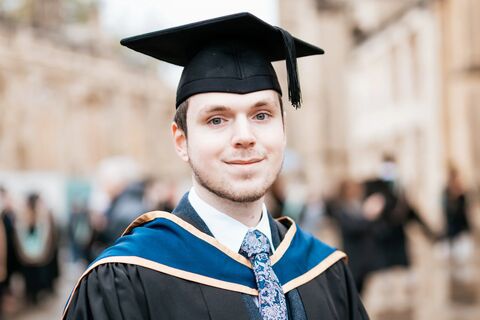
Throughout my education, I have faced challenges with demonstrating my knowledge and understanding in exams owing to dyslexia. Predicted low GCSE grades, I worked hard and with the support of my parents, I was moved up and achieved 9 GCSEs and 3 A-Levels. I accepted an unconditional offer to study BSc Environmental Geography at York St John University, where supportive lecturers and a course based on project work and a dissertation allowed me to build confidence and realise my potential to succeed at degree level.
My studies at York St John have helped me to develop my academic skills. I have gained experience using industry-relevant software such as ArcGIS and SPSS Statistics, alongside specialist equipment like mapping drones and water analysis tools. I also had the opportunity to go on field work trips in the UK and overseas to study different locations. The highlight of the course was a 5-day research trip to Slovenia and Italy, where we looked at studied areas of geological interest. However, the most memorable parts of my time at York St John have been shaped by the friendships I’ve made in my classes and societies.
With the continued support from my lecturers and family, I graduated with a 2:1 BSc (Hons) and progressed to an MSc in Environmental Management and Sustainability at York St John. Going from being predicted low grades at school to postgraduate study is an achievement I am proud of. My experiences have strengthened my resilience and confidence, highlighting the importance of an inclusive learning environment. I now hope to pursue a career in environmental management, applying my skills in mapping and remote sensing while continuing to build on the progress I have made during my time at York St John.
Dr Robin Gallagher, Doctorate in Philosophy
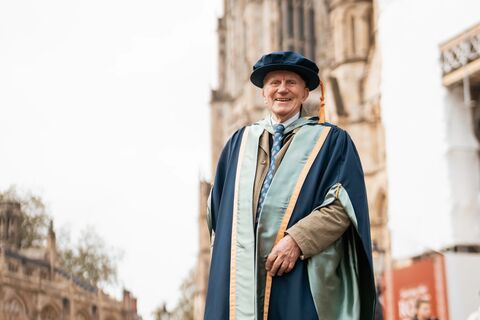
As an 85 year-old PhD graduate, my educational journey has been unconventional. While my 3 elder brothers went to university, I was advised that it was an unlikely option for me. I left school at 16 and trained as a Chartered Accountant, qualifying in 1963. After a career in finance and a gradual move into retirement, I wanted a new challenge. Aged 73, I began a Creative Writing course at Kirklees College in 2014, which led to an MA in Creative Writing at York St John in 2017 and, aged 79, a part-time PhD in 2019.
My PhD brought together my professional experience, interests, and childhood memories of North Wales. My research explored how the inheritance of family wealth and property can shape family relationships. Drawing on personal experiences and my financial career, I developed a Gothic family drama set in the Conwy Valley, supported by a critical explanation of my research.
The people I met at York St John are among the highlights of my PhD studies. Building friendships with other students in late 2019 proved invaluable when Covid restrictions moved teaching online. Despite studying some distance from the University, I benefited enormously from their friendship and encouragement. Together with the guidance and support of my supervisors, these connections made the 6-year commitment both rewarding and enjoyable.
My advice is to make the most of university life by connecting with other students, sharing experiences and seeking guidance from your supervisors. A PhD takes hard work, resilience and self-belief, but remember that you are the expert in your own research. Above all, have confidence in your abilities and embrace new challenges. My journey has shown me that it is never too late to pursue your ambitions and experience the rewards of lifelong learning.
Read about more recent graduates from York St John University: Class of 2025 Graduate Success Stories.